Tips for Hawaii’s National Parks: Haleakalā and Volcanoes

Disclosure: This post may contain affiliate links, meaning if you decide to make a purchase through my links we may earn a commission at no additional cost to you. The Hawai’i Vacation Guide has partnered with CardRatings for our coverage of credit card products. The Hawai’i Vacation Guide and CardRatings may receive a commission from card issuers. Read about our affiliate policies here.
Kilauea is on fire this year! At the time of writing, there have been over 43 episodes of Kilauea’s ongoing eruption, with more to come (February 2026). Even if Kilauea isn’t erupting, you shouldn’t miss visiting Hawaii’s national parks. For two people who visit the parks annually, here’s everything you need to know. Or, where to find everything you need to know!
A high school quarterback can’t match the confidence of a Kilauea volcanologist these days. The USGS Reports are bold in their predictions of when the next eruption at Kilauea will occur. Keep up with the latest eruption details on the Volcano Observatory Daily Update.
Each eruption has come with lava fountains and lava flows. Of course, Kilauea stopped erupting during our visit earlier this year. That’s fine; we’re not bitter. We’re fine. Totally fine. I’m fine!
While we explained to our children how fate, karma, and the universe work on timing a volcanic eruption, I realized we are overdue for sharing tips and tricks for visiting Hawaii’s two national parks – Haleakala on Maui and Hawai’i Volcanoes on Hawai’i.
While I am about to go deep into the national parks, don’t forget to visit Hawaii’s National Historical Parks. These historical parks are excellent places to visit for 30 minutes to a few hours to learn about Hawaiian culture. Here is a complete list of all NPS-managed parks and trails in Hawai’i.

Here are the best resources for visiting Hawaii’s national parks:
– Full Guide to Visiting Haleakala National Park
– How to Visit Hawaii Volcanoes National Park
– Decide whether to visit Haleakala at sunrise or sunset, and book a sunrise tour so you don’t have to drive.
– Take a private tour of Volcanoes National Park, or join a group tour.
– Learn about camping in both parks with these articles: Big Island Camping & Maui Camping
– Both parks can be visited as a shore excursion if you’re coming from a cruise ship: Big Island Shore Excursions & Maui Shore Excursions
Tips for Hawai’i’s National Parks
Here are high-level tips that apply to both of Hawaii’s national parks.
- The parks have limited food options, and no food is sold at the summit of Haleakala. Bring snacks with you!
- The parks are worth a full day on your itinerary. Map out your time at the park to see the sights on your list, the hikes you can’t miss, and where to get food.
- The only reservation required is Haleakala when entering the summit district between 3 AM to 7 AM. More information on planning for sunrise is below.
- Stay on the trails. Abide by signs to protect yourself, endangered species, and maintain the integrity of the trail system.
- Dress for the parks. Both parks are over 5,000 feet in elevation, so expect cooler weather. If visiting for sunrise, expect near-freezing temperatures. If visiting during the day, bring a light jacket or a sweatshirt.
- Check the park’s website before leaving your hotel to understand the operating hours and any last-minute closures due to safety or crowd concerns. A full parking lot will result in you being turned away from a major attraction.
- Here is the official website for Haleakala National Park and Hawaii’s Volcanoes National Park.
- While I’d love to sell you our island itinerary, which includes a day exploring the parks, you may not need it. Jeez, I’m a horrible salesperson. The NPS App helps you tour the park. It doesn’t provide a planned route, like our itinerary, but the app is free and very helpful. Our itineraries and the app complement each other!
Historically, our biggest mistakes when visiting Hawaii’s national parks have been not being appropriately dressed and not packing enough snacks or lunches. We were caught wearing t-shirts and shorts in 50-degree weather on the edge of Kilauea caldera in August one year!
I read somewhere that the temperature drops an average of 3 degrees F for every 1,000-foot rise in elevation. I’ve seen a girl in a bikini at 10,000 feet on Haleakala. True story. She was not happy.

Entrance Passes for Hawaii’s National Parks
Hawaii’s National Parks require a paid entrance pass. The standard pass can be purchased at the gates of both parks. The pass is $30 per vehicle.
The government offers some good deals for grabbing passes. Click here to learn more and buy a pass (official website).
- Senior Annual Pass (62+ years old) $20
- Senior Lifetime Pass (62+ years old) $80
- Access Pass for those with a permanent disability Free
- 4th Graders Free
- Military (Current and Gold Star Families and Veterans) Free
Let’s say you’re a wonderful son. You invite the grandparents to Hawaii with you. They have a Senior Annual Pass. You can use their pass to get the minivan full of Fromholzs into all the National Parks. They watch the kids while you go on a challenging hike. To celebrate, they offer to pay for lunch on their fixed income. Everyone wins.

Tips for Visiting Haleakala on Maui
Out of Hawaii’s national parks, Haleakala is the most accessible.
The nice thing about visiting Haleakala National Park is that it is a day trip from your resort. Wherever you stay on Maui, you can drive to Haleakala for the day or a few hours. See our Guide to Visiting Haleakala National Park for details.
Here’s our favorite way to spend a few hours at Haleakalā.
- We stock up on sandwiches and snacks in Makawao at the general store on Baldwin Avenue. You can’t miss it! Or, drive to Pukalani to stop at the Foodland or Puakalani Superette.
- Drive up to the park on the road full of switchbacks. It is a safe drive, but slow down around the curves, watch for bikers, and be extra careful in the clouds and fog.
- The entrance to the park is at 7,000 feet. Wait in line to get an entrance pass. The line moves fast.
- We drive to the summit at 10,023 feet. This is also called Red Hill. You can drive to the top and then take a few stairs up to the summit building for a great view.
- Red Hill is a great place to see ‘ahinahina (silverswords) in the parking lot.
- You can drive back down from the summit to the Haleakala Visitor Center parking lot. The Haleakala Visitor Center is open from sunrise to noon daily, with Rangers available to answer questions. But, they only staff it when Rangers are available.
- The Haleakala Visitor Center provides an excellent view of the crater. This is where folks watch the sunrise.
- We like to hike up to Pa Ka’oao from the visitor center. It is a short, rocky trail with a great viewpoint at the end.
- There is much more to do at the park, like hike the long and treacherous Sliding Sands Trail or head to Hosmer Grove for a 0.6-mile walk through an alien forest. But, we usually head to Upcountry Maui for farm tours, dinner, and other activities. Here is our Maui Upcountry Things to Do article.

We share two ways to experience Haleakala in our Maui Wayfinder Itinerary. Plus, a day just exploring Upcountry Maui. If you need details on stops, alternatives, and more, grab our Maui Wayfinder Itinerary.
The trick for visiting Maui’s National Park is that the standard pass is good for three days of access. You can visit Haleakala and then use your pass within 3 days to see the Kipahulu District for the Bamboo Forest, Pipiwai Trail, and Pools of ‘Ohe’o (Seven Sacred Pools). You can also do this in reverse order: Kipahulu and then Haleakala.
Kipahulu District is 12 miles past Hana and is a gem to visit. It is our #5 stop in our Road to Hana Guide. If you are thinking of doing the Road to Hana, read that guide to get started!
One of our favorite Road to Hana Tours is a private tour that takes you to the Kipahulu District to hike the Pipiwai Trail (the Bamboo Forest is on the Pipiwai Trail) before the crowds arrive. They will then drive you along the Road to Hana taking you to all the famous stops, or wherever you want to go as it is a private tour! Learn more about this Private Road to Hana Tour here.
I apologize in advance for not recommending a downhill bike riding tour company. We have never done the bike ride down. We hear that visitors love it, but we also read about the numerous fatal accidents and traffic problems from the biking tours. If you decide to bike down, please book a tour where the guides stay with you the whole time.

Sunrise vs Sunset on Haleakala
For Maui, our favorite tip is to skip sunrise and go for sunset, as sunset doesn’t require a permit. The second benefit is that you can see from the valley if you have a clear sky for sunset. For sunrise, it is a crap shoot on the weather.
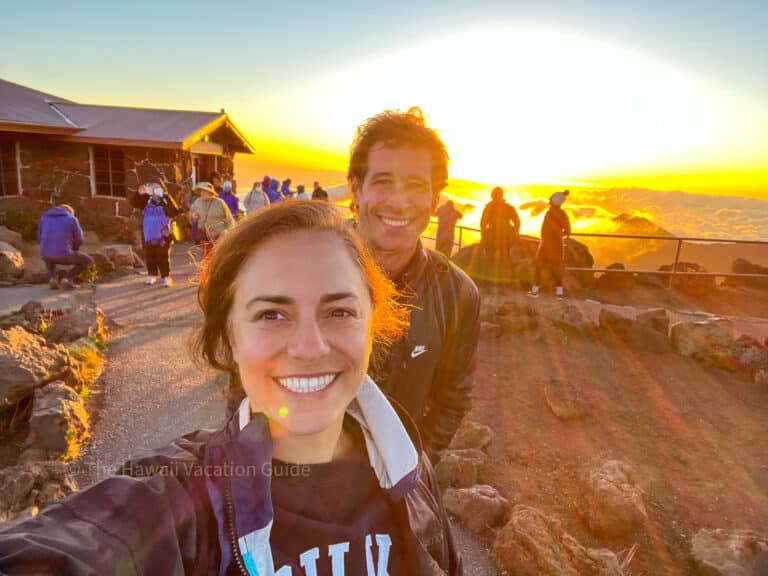
But, sunrise is worth the gamble. The tour guides sing an oli (Hawaiian chant) as the crater gives birth to the sun, hence Haleakala means House of the Sun. You can get a permit for sunrise here.
We break down the pros and cons, plus details on visiting, in our Haleakala Sunrise or Sunset: When Should You Go?
We enjoy having a local tour guide get the permit, pick us up at 3:30-ish at our hotel, and tell us stories on the way up. We share our favorite Haleakala Sunrise Tours here, and you can get 10% off with Valley Isle Excursions here.
Video Guide to Haleakala National Park
Erica and I enjoy sharing our Hawaii travel experiences. Click to watch our full guide to visiting Haleakala National Park on Maui.
Visiting Hawaii’s national parks is an exceptional experience. Watch the video to get a taste of the out-of-this-world scenery.
How to Visit Hawaii’s Volcanoes National Park
Out of Hawaii’s National Parks, Volcanoes is my favorite for an out-of-this-world experience. From walking through lava tubes and fern forests where a dinosaur can jump out at you, and the chance to safely view an erupting volcano, it is hard to beat Volcanoes National Park.
The volcanoes in Volcanoes National Park are Kilauea and Mauna Loa. Mauna Loa rarely erupts. The last Mauna Loa eruption was in November 2022 and the one before that was in 1984. When Pele erupts Mauna Loa, it is a big deal as she is a big volcano.
Kilauea is the most active volcano on the planet. Kilauea has been erupting almost continuously for the past few decades. In the past couple of years, she has stopped and started again. Hawaii’s Volcanoes National Park visitor center and the main part of the park are around the Kilauea caldera.
See our Full Guide to Visiting Hawaii Volcanoes Park for an itinerary and guided tours.

There are three ways to visit Hawaii’s Volcanoes National Park.
- A day trip from Kona is the most popular way to visit the park, but the journey takes about two hours one-way, making for a long day.
- A day trip from Hilo is a shorter drive (45 minutes), and you can get to the park before the crowds arrive at 10 AM.
- Stay in Volcano or Fern Forest for a shorter drive, but with limited dining options and nighttime activities.
We have done all three options numerous times. Driving from Kona is the most convenient way to sneak a trip to the park. We include such a day in our Big Island Wayfinder Itinerary. The best part of the drive is a stop at Punalu’u Black Sand Beach.
As you drive around the southern cape, you can consider stopping at South Point Park to visit the southernmost point of the United States. Plus, there is cliff jumping for those crazy few. Explore our 15 South Point, Hawaii, Things to Do for details.
The video below shows us the road trip to Volcanoes National Park from Kona. Watch our adventure with my parents and my son to see if this entices you to make the drive. Details on the trip can be found in our itinerary!
We enjoy staying two or three nights in Hilo on 6+ day trips to the Big Island. Hilo has a lot to do in the area. See our Hilo Things to Do or Big Island Waterfall articles to get excited about staying in Hilo. Our classic reasons to not spend more time in Hilo is the high probability of rain and the limited number of hotels. Most hotels are two-star. See our Hilo vs Kona article for details.
Check out our video below for a full day visiting Volcanoes National Park. We stayed in Fern Forest during that trip. We stayed in this Yurt! It was a unique experience and very comfortable. Here are more Unique Stays on the Big Island.

Tips on Visiting Hawaii’s Volcanoes National Park
- Driving times to Volcanoes are the following:
- Waikoloa Resorts: 2 hours if you take the Saddle Road
- Kailua-Kona: 2 hours 15 minutes when you take the southern route
- Hilo: 45 minutes
- Visitor Centers:
- Kilauea Visitor Center is open 9 AM – 5 PM daily, but is being remodeled in 2025
- Kahuku Visitor Contact Station is open 8 AM – 4 PM Thursday through Sunday
- Busy times: The park gets busy at 10 AM when the Kona crowd arrives, holidays and summers are busier, and when the volcano erupts.
- Check the park’s website for the best viewing locations when the volcano erupts!
- How to get around the park: Driving is crucial. You drive to the popular spots or trailheads. The Hele On Bus goes to the visitor center daily (can be delayed or change schedules) from Hilo and is free of charge. But, there is no public transportation around the park.
- The most popular sights to visit are the following: Kilauea Caldera, Steam Vents, Sulfur Banks, Thurston Lava Tube, Chain of Craters Road, Devastation Trail, and Kilauea Iki trail.
- Self-guided tours are the most popular way to see the park. NPS also provides a free app, learn more here.
- Guided tours are a great way to experience the park! Joel showed us around earlier this year. Tours, like this one, will drive you from Kona to the park.
- Kahuku Unit is further south than the main entrance and is rarely visited. The unit has hikes ranging from ½ a mile to 7 miles. See our video below for details on visiting this hidden gem at Volcanoes National Park.
- There are eight backcountry campsites in Volcanoes National Park and a simple reservation system. Reservations may be simple, but all eight sites require challenging hikes, so read our Big Island Camping Guide before choosing a site!

Where to Stay at Hawaii’s National Parks
Neither of Hawaii’s National Parks has many places to stay near the park entrance. As we mentioned, you don’t have to stay near the parks to enjoy them.
The closest hotel to Haleakala on Maui is the Kula Lodge. The lodge has rooms and a restaurant. It is located about halfway up Haleakala, making it a convenient place to stay when visiting the park. The hotel and restaurant is famous for the bi-coastal Maui view over the Central Valley.
The hotel and restaurant are a bit dated, but a new owner (the former owner of the Five Palms in Kihei) is reviving this famous Maui institution.
There are also a few B&Bs and vacation rentals in Upcountry Maui. They are hard to find as the area is not a vacation rental area on Maui but some homes have grandfathered permits.
At Volcanoes National Park, you can stay at Volcano House. We loved staying at Volcano House a few years ago, and we plan to stay again. The old hotel is dated and needs an upgrade, but that is part of the charm. You feel transported to the days when hotels were built on the edges of active volcanoes. Because that is where this hotel is located. All the rooms have a few of the smoking caldera.
We give a tour of our stay in our video below. Make sure you book early. If you can’t get a room at Volcano House, we recommend visiting them for lunch or dinner. The hotel has two restaurants to choose from: The Rim for fine dining and Uncle George’s Lounge for casual fare.
A four-minute drive from the main entrance to Volcanoes National Park is the charming town of Volcano. The town is known for its art galleries and vintage vibe. There are a few restaurants and food trucks in Volcano. We recommend checking hours ahead of time as hours are not consistent. We share our favorite places to eat in Volcano in our Big Island Wayfinder Itinerary.
For places to stay, you can book the Kilauea Lodge or a few vacation rentals in Volcano. For more affordable options, head to Fern Forest, which is 15 minutes south of Volcanoes National Park. You will find well-priced vacation rentals on Airbnb and VRBO.
Closing Thoughts on Hawaii’s National Parks
Thank you for taking the time to research Hawaii’s National Parks before your visit. You are setting your group up for a great tour of these famous national parks by figuring out your itinerary ahead of time.
With so much to do and see in these parks, it’s worth taking the time to map out the things you shouldn’t miss. For Haleakala National Park, most visitors drive to the summit for the view and drive back down. That is fine. If you have more time, head to Hosmer Grove and/or do a short hike at the summit.
Volcanoes National Park is easier to see more sights in a shorter time. Starting at the visitor center, you can continue straight for views of the caldera and to walk around the sulfur ponds and steam vents. Then, drive down Chain of Craters Road to stop at some of the famous lava tubes, hikes, and craters. Do what you have time for on your day!
Since you made it to the end, make sure to finish the rest of your Hawaii trip planning with one of our fantastic itineraries. They will finish your planning so you can stop browsing the internet for honest advice on Hawaii. Have a wonderful trip to Hawaii’s National Parks!