Hawaii Reef-Safe Sunscreens: How to UV-Protect Yourself

A quick note: we’ve included a few affiliate links below. Booking through them costs you nothing extra and sends a small commission our way, which helps us keep writing free Hawaii guides. We only ever link to things we’d recommend to a friend. Mahalo! Read about our affiliate policies here.
The sun and sea await you on your Hawaii vacation. Before you lather up on sunscreen, wear sunscreen that doesn’t contribute to coral reef bleaching while protecting you from the tropical, harsh Hawaiian sun.
Hawaii reef-safe sunscreens do not contain oxybenzone and octinoxate chemicals, contributing to coral bleaching. Read the sunscreen’s ingredients before buying. Look for sunscreens containing natural minerals like zinc oxide or titanium dioxide, which are labeled non-nano and paraben-free.
Since January 1st, 2021, sunscreens containing oxybenzone and octinoxate have been banned for sale and distribution in Hawaii. These chemicals have been found to contribute to coral reef bleaching.
In addition, legislation in Maui and the Big Island of Hawaii only allows the use of mineral-based sunscreen. So check that label before you bring sunscreen with you!
412 pounds of sunscreen are deposited daily on Hanauma Bay’s reef, Oahu’s most popular snorkeling spot (2,600 swimmers a day). The study by the National Academy of Sciences made me understand the impact these chemicals have on Hawaii’s reefs.
You can still bring reef-unfriendly sunscreens to Hawaii without fearing a ticket at the beach but why be that person?
There are other ways to keep yourself UV-protected while protecting Hawaii’s reefs. Using Hawaii reef safe sunscreens is one way.
Keep planning your trip with some helpful resources:
– Check out 15 Essential Planning Details to set yourself up for success
– Reef safe sunscreen is on our Packing List, complete with everything else you’ll need
– Stay at the best hotels and vacation rentals for any budget with our Where to Stay database
– See what you don’t even know you might be missing with our Activities database
21 Hawaii Approved Reef-Safe Sunscreens
The more I research reef-safe sunscreens, the more complicated the problem becomes. To make your search easier for Hawaii reef-safe sunscreens, here are 21 sunscreens that will protect you from the sun and are reef-safe (per current research).
The best thing you can do to protect Hawaii’s reefs is to reduce the amount of sunscreen you apply. Wear sun-protection clothing and use rub-on sunscreens. I’ll get off my soapbox now.

Hawaii Sunscreen Law
The Hawaii law banning most sunscreens is as follows:
Beginning January 1, 2021, bans the sale, offer of sale, or distribution in the State of any sunscreen that contains oxybenzone or octinoxate, or both, without a prescription issued by a licensed healthcare provider to preserve marine ecosystems. Hawaii law: SB2571 SD2 HD2 CD1
My four main take-aways from this law are the following:
- One can’t buy sunscreens containing oxybenzone and/or octinoxate in Hawaii
- One shouldn’t bring sunscreens to Hawaii containing these two chemicals
- Unless they have a prescription from their doctor
- One won’t get a ticket or fine on the beach if they are using sunscreen with one or both of those chemicals
Free Download!
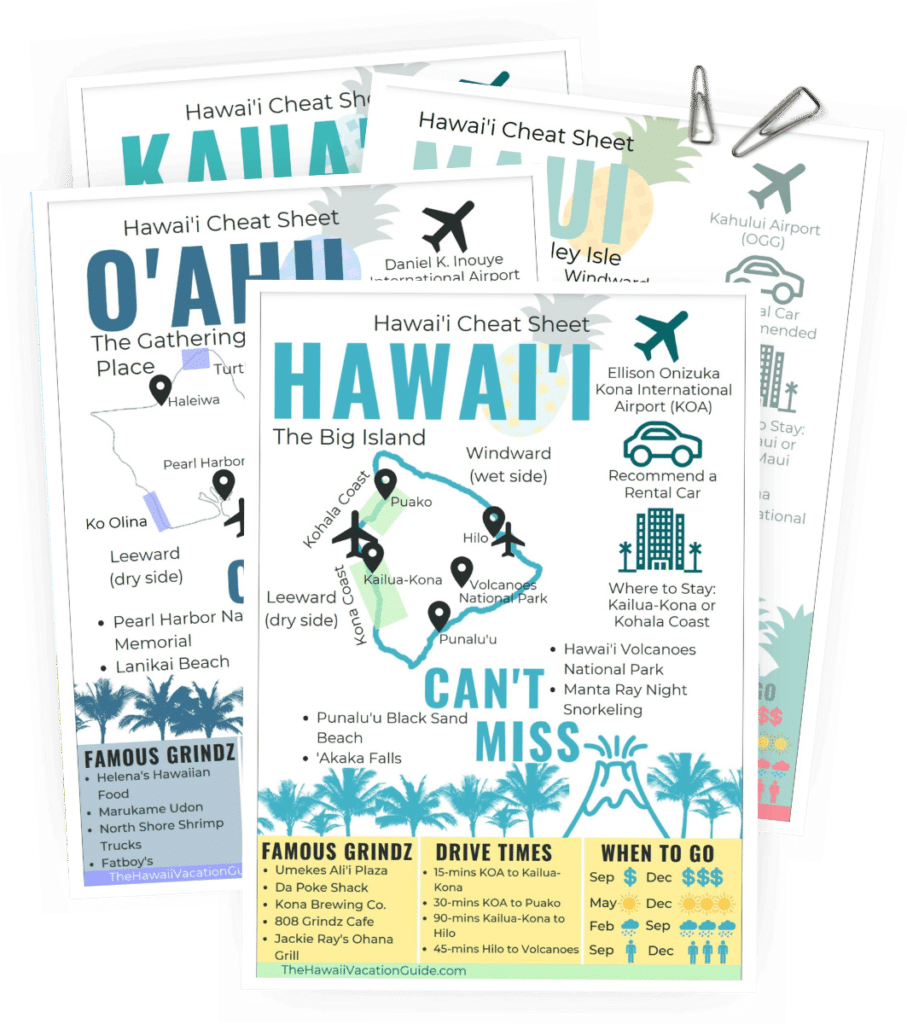
Hawaiian Island Cheat Sheets
Sign up & we’ll send you our island cheat sheets so you can get to know the islands like the back of your hand!
We’ll share 4 can’t-miss activities on each island, a map with the main sights in town, & famous local grindz (eats)!
Best Reef-Safe Sunscreens to Buy
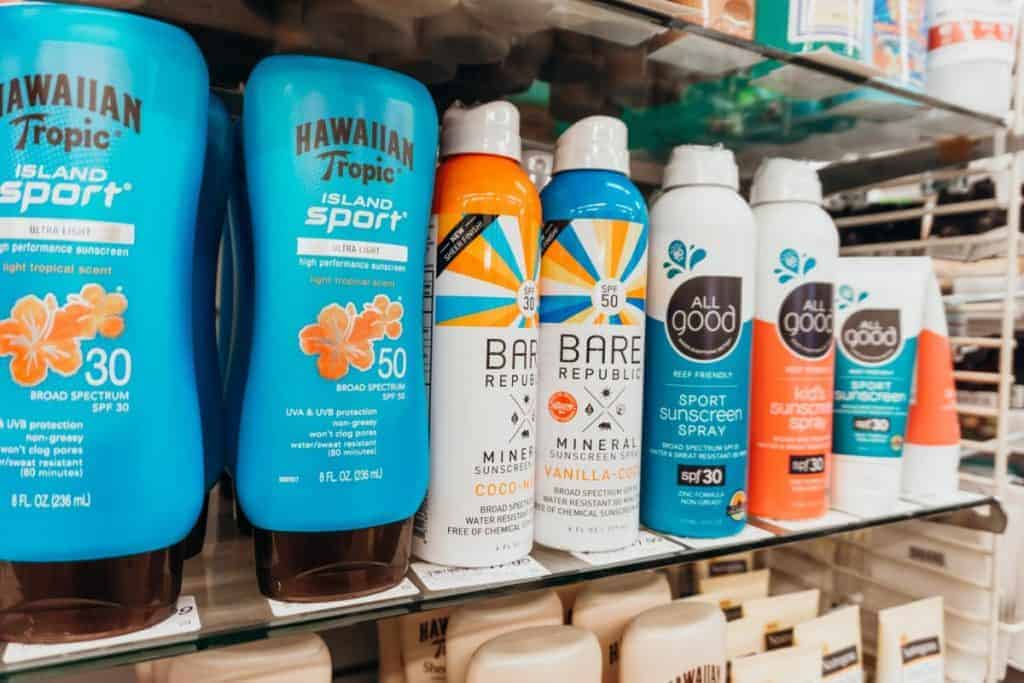
Here is a list of sunscreens that are considered reef-safe in Hawaii, as they do not contain the chemicals oxybenzone and octinoxate.
Prices per fluid ounce listed are from Amazon or the manufacturer, if not sold on Amazon.
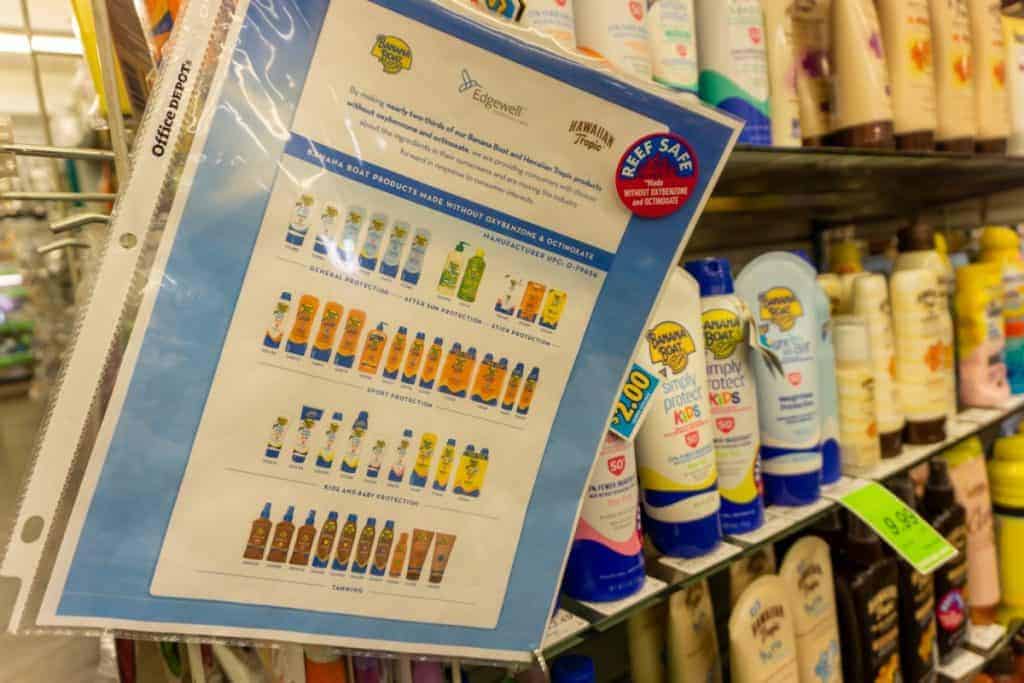
Many of the big sunscreen brands, such as Banana Boat and Hawaiian Tropic, have already been reformulated for sale in Hawaii.
Mineral-Based Sunscreens (Hawaii Approved)
- Raw Elements SPF 30 $8.20/oz
- Blue Lizard Sensitive Mineral Sunscreen $3.33/oz
- Thrive SPF 50 $5.16/oz
- Thinksport SPF 50 Sunscreen $4.67/oz
- All Good SPF 30 Sport Sunscreen Lotion $6.66/oz
- Suntegrity Natural Mineral Sunscreen $8.67/oz
- Badger SPF 30 Unscented Sunscreen Cream $5.86/oz
- Stream2Sea SPF 30 Mineral Sunblock $7.18/oz
- Babo Botanicals Vegan Sunscreen SPF 30 $6.00/oz


Aloha! I’m Jordan,
Co-founder of The Hawai’i Vacation Guide with my wife Erica. After living on both Maui and Oʻahu, we’ve turned our passion for the islands into a resource that cuts through the tourist noise. We share genuine experiences—from snorkeling spots to hikes—and connect travelers with authentic Hawaiian culture and ‘āina (land). Our mission is simple: make your Hawaiian adventure both seamless and meaningful.
Thanks for joining us on the journey—aloha and happy travels!
No Oxybenzone or Octinoxate Sunscreens (Hawaii Approved)
10. Walgreens Hydrating Lotion SPF 50 sunscreen $1.66/oz. (highest Consumer Reports score)
11. Alba Botanica $2.00/oz
12. Banana Boat UltraSport $1.10/oz (new formula)
13. Hawaiian Tropic Sheer Touch Lotion, Sport, and Silk Hydration $1.12/oz
14. Sun Bum Original SPF 30 Sunscreen Lotion $2.31/oz
15. Ocean Potion Sunscreen Lotion SPF 50 $1.91/oz
16. Banana Boat Simply Protect SPF 50+ Sunscreen $1.38/oz
Best Hawaiian-Made Reef-Safe Sunscreens
17. Kokua Sun Care Hawaiian SPF 30 Natural Zinc Sunscreen $10.00/oz
18. Mama Kuleana Waterproof SPF 30 Reef-safe Sunscreen $11.04/oz
19. Little Hands Hawaii SPF 35+ All-natural and Organic Sunscreen $6.47/oz
20. Raw Love SPF 30 All-natural Mineral Sunscreen $8.00/oz
21. Project Reef SPF 50 Mineral Sunscreen, 80 minutes water resistant $7.65/oz
If you’re interested in more recommendations for your suitcase besides sunscreen, check out our favorite gear.
Aloha! I’m Jordan,
Co-founder of The Hawai’i Vacation Guide with my wife Erica. After living on both Maui and Oʻahu, we’ve turned our passion for the islands into a resource that cuts through the tourist noise. We share genuine experiences—from snorkeling spots to hikes—and connect travelers with authentic Hawaiian culture and ‘āina (land). Our mission is simple: make your Hawaiian adventure both seamless and meaningful.
Thanks for joining us on the journey—aloha and happy travels!
Related reads:
The 24 Best Beaches in Hawaii
The Best Snorkeling in Hawaii by Month
The Best Time to Visit Hawaii

Where to Buy Reef-Safe Sunscreen
Per Hawaii law, all sunscreens sold in Hawaii will be reef-safe. You can buy it once you land at all Hawaii grocery stores, Costco, department stores, and convenience stores.
It is often given out for free on tours, like whale watching in Maui.
You may even find free Hawaii reef-safe sunscreen available at the beach. Look for a metal dispenser at the beach entrance or near the beach shower.
With a 6-ounce bottle of sunscreen averaging $12.99 at a grocery store in Hawaii, you may want to bring your sunscreen from home. If you are already checking a bag, throw your reef-safe sunscreen in there too.
If your sunscreen contains chemicals oxybenzone and octinoxate on the listed ingredients, then head to the following stores to buy reef-safe sunscreen.

Walmart’s Reef-Safe Sunscreen
Walmart carries all the big brands so look for Hawaiian Tropic and Banana Boat (for reef-safe sunscreens. They also stock natural brands like Blue Lizard.
Costco’s Reef-Safe Sunscreen
Costco’s reef-safe or reef-friendly sunscreen is Sun Bum Original (spray). As of 2025, the Sun Bum SPF 50, 5-oz, 2-pack is $24. This Sun Bum is oxybenzone and octinoxate-free. Costco sells other sunscreens, but make sure they don’t contain those two chemicals.
If you stay for more than a week or have a big family, Costco is your cheapest source of sunscreen in Hawaii.

What is the Difference Between Reef-Safe and Reef-Friendly Sunscreen?
There is no agreed-upon term for reef-safe or reef-friendly sunscreen products. The terms are not regulated, and the FDA has not considered the issue by setting a standard.
So if you are confused about what is safe for marine life, we are with you.
Reef-safe and reef-friendly are used interchangeably at this time.
Reef-safe or reef-friendly sunscreens are sunscreens that do not contain chemicals oxybenzone or octinoxate.
When Hawaii passed a law banning the sale of sunscreens containing chemicals oxybenzone and octinoxate, that became the de facto definition of reef-safe or reef-friendly, the city of Key West Florida passed a similar law shortly after Hawaii.
The truth is, though, no sunscreen has been proven to be safe for marine life.
Related reads:
The 24 Best Beaches in Hawaii
The Best Affordable Family Resorts in Hawaii
The Best Hawaiian Island to Visit
Travel to Hawaii for (almost) Free
Free nights, free flights, let us show you how! Grab our guide that walks you through our strategy to earn points and book our favorite luxury Hawaii hotels for free.

Reef-Safe Sunscreen: What Does That Mean?
Here is an origin story for you. This is how reef-safe sunscreen legislation got traction in Hawaii.
A study was done on the Fine-Scale Geographic Risk Assessment of Oxybenzone Sunscreen Pollution within Hanauma Bay using Hydrodynamic Characterization and Modeling. We have a YouTube video with the same title, but it didn’t do well.
Besides defining a Risk Quotient Plume, it found that 412 pounds of sunscreen are deposited daily on Hanauma Bay’s reef, Oahu’s most popular snorkeling spot. Hanauma Bay made our list of the Top 5 Snorkeling Spots on Oahu.
The National Park Service estimates that 6,000 tons of sunscreen enter reef areas yearly, with the most significant damage in popular reef areas in Hawaii and the Caribbean. But why should we care?
Researchers found in a separate study that Oxybenzone and Octinoxate, two of the eight active sunblocking chemicals in sunscreen, blocked coral from developing. That was the nail in the coffin, per Hawaii legislators. Our sunscreen was killing baby coral.
Hawaii and the Florida Keys both enacted laws to stop the sale of sunscreen with those two chemicals.
Time to get nerdy. Let’s talk about chemicals.
The active ingredient in sunscreen acts as a UV filter. The most popular sunscreens contain chemical filters. The active-ingredient chemicals you will find listed are the following:
- oxybenzone
- avobenzone
- octisalate
- octocrylene
- homosalate
- octinoxate

Sunscreen manufacturers will use a combination of two to six of these chemicals.
Mineral sunscreens use zinc oxide and/or titanium dioxide.
Some manufacturers use both chemicals and minerals. For example, the popular baby-safe sunscreen (in our drawer now) Coppertone Water Babies uses oxybenzone as the active ingredient and zinc oxide as the mineral base. It will be illegal to sell this sunscreen in Hawaii by January 1st, 2021.
The study by the non-profit Haereticus Environmental Laboratories in partnership with NOAA found oxybenzone and octinoxate to cause coral bleaching. The authors found that baby coral exposed to oxybenzone and octinoxate showed signs of distress, including coral bleaching.
Coral bleaching is a condition that doesn’t kill coral but leaves it in severe stress, exposing it to infection and may lead to death. The chemicals also caused DNA damage and irregularities in their growth and skeleton.
Scientists are continuing to study other sunscreen ingredients to determine their impact on ocean life, like avobenzone, octisalate, octocrylene, and homosalate. The Journal of the American Academy of Dermatology stated that more research is required to comprehend the impact of sunscreens on coral.
The National Park Service estimates 6,000 tons of sunscreen enters reef areas every year, with the greatest damage found in popular reef areas in Hawaii and the Caribbean.
In 2015, the Haereticus Environmental Laboratory surveyed two locations to determine the amount of sunscreen deposited on reefs from swimmers, this is what they found.
- 6,000 pounds of sunscreen are deposited annually in Trunk Bay beach, located on St. John, where visitors range from 2,000 to 5,000 swimmers daily
- 412 pounds per day of sunscreen in Hanauma Bay, located in Oahu, where visitors average 2,600 swimmers daily.
Sunscreen isn’t the only foe of healthy reefs. Other pollutants include ocean warming, agricultural runoff, and sewage dumping. But banning harmful chemicals is one variable that swimmers and the State of Hawaii can control.
Related reads:
The 11 Best Snorkeling Spots on Maui (+ 7 crucial tips)
What is the Cheapest Hawaiian Island to Visit?
7 Tips on Hawaii Reef-Friendly Sunscreen
Erica and I did everything wrong when it came to sun protection. When we moved to Maui, we bought “baby-friendly” sunscreen with octinoxate, we used sprays at the beach, and were reluctant to buy sun protection clothing. We didn’t know any better.
And to be honest, scientists are still figuring out what chemicals in sunscreen harm the reefs, marine life, and us humans. Studies continue but for now, Erica and I implement these 8 sun UV-protection tips to stay safe and help the environment. All while enjoying Hawaii.
We want the snorkeling to be even better for our kids when they are older.
When we go to Hawaii, this is how we UV-protect ourselves:
- Wear sun-protective clothing to minimize the amount of sunscreen
- Purchase mineral-based sunscreen before we leave. Our favorite sunscreen is Blue Lizard, for the price and how it applies.
- Mineral-based sunscreen should be nano-free and paraben-free.
- Avoid spray-on sunscreen, as most will end up on the sand or in the water.
- Buying local sunscreen is a great option, too. We always do this as we never bring enough sunscreen, or we don’t check our bags.
1. Wear Sun Protection Clothing
Avoiding sunscreen is the simplest solution. Cover yourself, not just your kids, in sun-protecting clothing – hats, shirts, shade, and 100% UV-protection sunglasses.
You can buy UPF-rated clothes (we have our favorites) or just wear a plain t-shirt.
Consumer Reports testing found that white T-shirts provided as good, if not better, UV protection than advertised UPF-rated clothing, even when wet.

2. Choose Non-Nano Lotions
Look for products labeled as “non-nano.” Studies have found that marine animals and coral reefs can ingest particles less than 100 nanometers.
Manufacturers of mineral-based sunscreens have made the minerals zinc oxide and titanium oxide nanoparticles so that the sunscreen applies smoothly and is transparent. No one wants a white nose anymore.
Buy “non-nano” advertised lotions and sunscreens to protect the reef and marine life.
3. Avoid Oxybenzone and Octinoxate
Buy sunscreen that doesn’t list these chemicals on the label; that is the basic definition of reef-safe at this time.
As of January 1st, 2021, Hawaii has banned the sale of sunscreens containing oxybenzone and octinoxate. Check the label on your sunscreen, as one of these chemicals may be listed as the active ingredient.
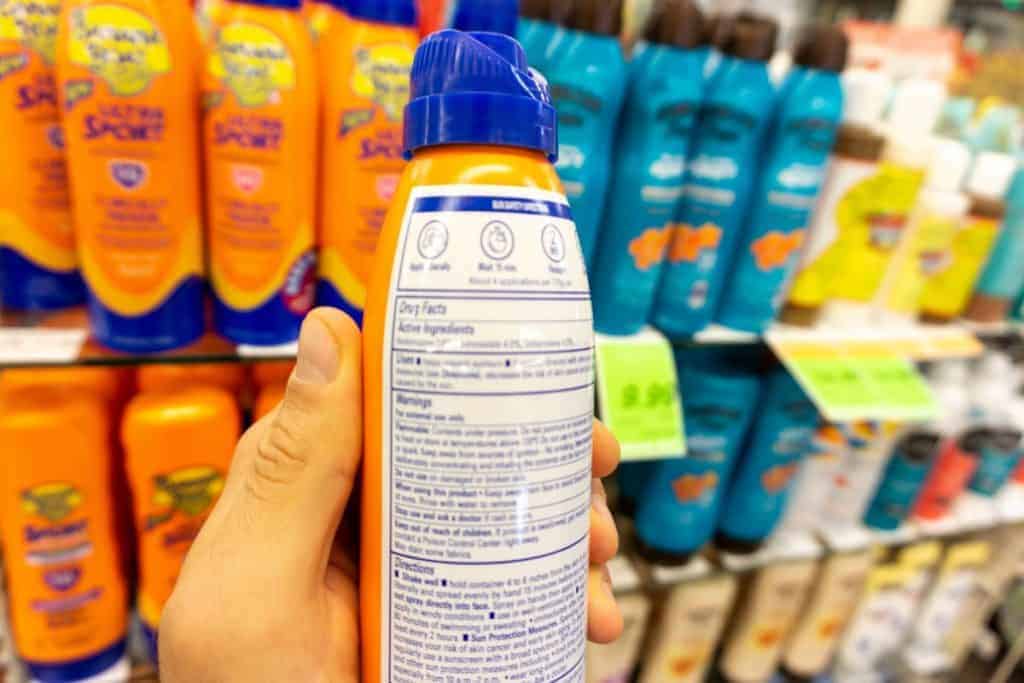
4. Use a Rub-On Sunscreen
Spray-on sunscreens are super convenient. One can even buy reef-friendly spray-on sunscreens. The problem with spray-on is that the spray goes everywhere. It covers the sand, which then washes into the ocean.
Use rub-on sunscreens when at the beach.
Also, spray-on sunscreens are not recommended for children as the spray is more susceptible to getting in their eyes and mouth. The FDA recommends against using sprays on kids because of the likelihood of inhalation and respiratory problems like asthma. Also, sprays don’t cover as well as rub-on lotions.
5. Buy “Paraben-Free”
Here is another chemical to avoid: Parabens are used as preservatives in lotions, skin-care products, and sunscreens.
Butylparaben has been shown to cause coral reef bleaching, and there are some health concerns surrounding parabens in general.
Manufacturers have heard of the concerns, so they removed parabens and marketed their products as “paraben-free.” Look for a Paraben-Free label on the sunscreen you purchase or make sure butylparaben is not in the list of ingredients.
6. Buy Good Water-Resistant Sunscreen
“Water Resistant” sunscreens are formulated to stay on in the water or during a good sweat. Nothing is waterproof, so buy water-resistant for 80 minutes. That is the max protection label per the FDA. The two ratings are the following:
🍍 Water-resistant for 40 minutes
🍍 Water-resistant for 80 minutes
No sunscreen can withstand a towel, so remember to reapply after you towel off or put on your sun-protecting clothing.
7. Best Practices for Applying Sunscreen
Here are some quick best practices for applying reef-safe sunscreen.
🍍 Apply 15 minutes before going out in the sun
🍍 Reapply every 2 hours, more if you towel dried
🍍 Cover every inch of exposed skin with sunscreen
🍍 Pack enough for your trip out that day
🍍 Skin Cancer Foundation recommends SPF 30 or higher for extended outdoor activities.
That is a lot of chemicals to avoid when buying sunscreen so let me summarize. Avoid sunscreens with the following ingredients on the label:
🍍 Oxybenzone
🍍 Octinoxate
🍍 Parabens (butylparaben)
🍍 Nanoparticles (look for “nano-free” label)
Related reads:
The 59 Best Things to Do in Hawaii
Hawaii Vacation Guide Coupon Codes
22 Hawaii Honeymoon Things to Do
Hawaii Reef-Safe Sunscreen Final Thoughts (Video)
As a professionally licensed Chemical Engineer who also likes to write about Hawaii, sunscreen chemicals are near and dear to my heart.
I am not a sunscreen expert. I don’t know everything about sun protection, but I do know I want to keep my kids safe. Practicing chemical engineering made me respect chemicals, their power, and what we don’t know about them.
Analytical chemistry is now measuring chemicals in the environment at the part per billion and lower level. We know the chemicals are in the environment now, we know they are from humans, and we don’t know if they are safe or not.
We worry about what we can control. We can control how we protect ourselves from UVA and UVB radiation. For now, the best answer is to wear sun protection clothing with a mineral-only sunscreen.